Get Factory-Direct Wholesale Pricing & Catalog - WhatsApp:8615954555812!

Remote Control Lawn Mower for Orchards: A Practical Guide to Mowing Between Tree Rows
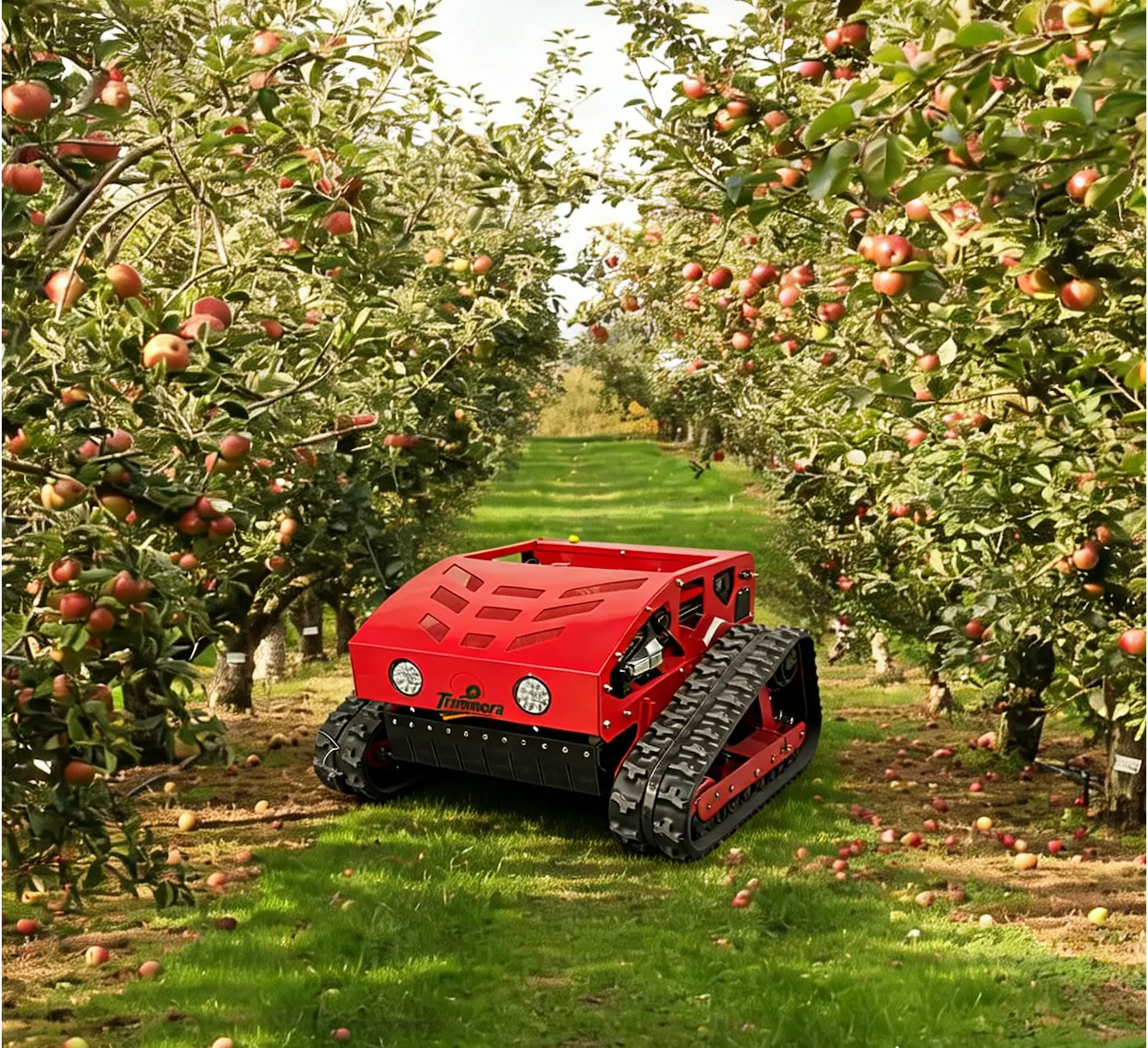
Managing vegetation in an orchard differs greatly from maintaining a conventional lawn.
Orchards often combine narrow tree rows, uneven ground, low branches, wet soil, slopes, irrigation equipment, fallen vegetation, and dense grass or weeds. Traditional mowing equipment can become difficult to maneuver when access is restricted or when the terrain makes it uncomfortable or unsafe for an operator to remain on the machine.
A remote-controlled lawn mower for orchards offers another approach. Instead of carrying the operator through the work area, the mower can be controlled remotely while the operator stays in a suitable position with a clear view of the machine.
However, for orchard owners, agricultural contractors, and equipment distributors, remote operation alone is not enough. The mower must also match the orchard's physical conditions.
This guide explains what to consider when selecting remote-controlled mowing equipment for orchards and agricultural land.
Why Orchard Mowing Is Different
An orchard is not simply a large lawn with trees added.
The machine has to work around permanent obstacles while maintaining enough cutting performance to control vegetation.
•Common orchard conditions include:
•Narrow spaces between tree rows
•Low branches and tree canopies
•Uneven or sloping ground
•Tall grass and weeds
•Dense ground vegetation
•Wet or soft soil
•Irrigation systems
•Fences and posts
•Fallen branches and leaves
• Different soil conditions throughout the year
These conditions create different requirements than those found in open commercial landscaping. The key question, then, is not simply whether a mower can cut grass.
The more important question is:
Can the mower move through the orchard, maintain traction, cut the required vegetation, and operate without interfering with trees, irrigation systems, or other infrastructure?
Where Remote-Controlled Mowers Can Be Used in Orchards
Remote-controlled mowing equipment can be useful in several parts of an agricultural property.
Between Tree Rows
The area between tree rows often requires regular vegetation management.
Grass and weeds compete for space and resources, and excessive vegetation can make access harder for workers and agricultural equipment.
A compact mower with suitable dimensions can travel along the rows while the operator controls its direction and cutting operation from a distance.
Always compare the machine width with the actual distance between rows rather than relying on a general description such as "compact."
Under and Around Tree Canopies
Low branches can create clearance problems for conventional ride-on equipment.
A remote-controlled machine lets the operator maintain a better viewing position. At the same time, the mower works beneath or around tree canopies, as long as the machine's height and dimensions suit the site.
Before purchasing, buyers should measure the lowest practical clearance rather than assuming that every remote-controlled mower will fit.
Sloped Orchard Land
Some orchards are located on hillsides or rolling agricultural land.
Slopes introduce additional requirements for:
•Traction
•Stability
•Machine weight
•Center of gravity
•Track design
•Operating direction
•Operator position
A mower's maximum advertised slope angle should therefore not be treated as a universal operating limit.
Actual performance depends on the terrain, surface condition, vegetation, machine configuration, direction of travel, and other site-specific factors.
Why Tracks Can Be Useful in Orchards
Tracked remote-controlled mowers can offer advantages in agricultural environments where the ground is uneven or traction is difficult to maintain.
Tracks distribute the machine's weight across a larger contact area and can help maintain traction on surfaces where conventional wheels may struggle.
This can be useful on:
•Uneven agricultural soil
•Sloped ground
•Wet grass
•Loose soil
•Rough orchard access areas
•Vegetation-covered terrain
However, tracked equipment is not automatically the right choice for every orchard. Consider machine width, total weight, turning behavior, ground pressure, and soil condition. For example, an orchard with narrow rows and relatively firm ground may have very different requirements than a hillside orchard with wet, loose soil.
Orchard Vegetation Requires the Right Cutting System
Another important consideration is the vegetation you're managing.
An orchard mower may encounter much more than short lawn grass. Depending on the property, vegetation can include:
•Short grass
•Tall grass
•Weeds
•Thick ground cover
•Brambles
•Dense brush
•Seasonal vegetation
•Fallen plant material
The cutting system needs to match the actual vegetation. A mower designed primarily for fine lawn finishing may not suit dense agricultural vegetation. Commercial orchard buyers should therefore evaluate the complete mowing system rather than focusing on engine horsepower alone. Cutting width, blade design, cutting height, travel speed, power output, and vegetation density all affect productivity.
Cutting Width: Productivity vs. Maneuverability
Cutting width matters a lot in orchards. A wider cutting deck can cover more ground per pass and potentially increase productivity. However, a wider machine also requires more space between trees. This creates a practical trade-off.
A wider mower can provide:
•Greater coverage per pass
•Higher potential productivity
•Fewer passes over large open areas
A narrower mower can provide:
•Easier movement between rows
•Better access in restricted areas
•More flexibility around obstacles
•Easier transport in some situations
The correct choice depends on the actual orchard layout. Before selecting equipment, measure the narrowest working area rather than using the average row spacing.
Gasoline or Electric: Which Is Better for Orchards?
Power system selection is another important consideration.
Gasoline Remote-Controlled Mowers
Gasoline-powered machines can be attractive for demanding agricultural applications where high power output and long operating periods matter.
They may be suitable for:
•Dense grass
•Heavy weeds
•Brush
•Large agricultural properties
•Long working periods
Also consider fuel availability and engine maintenance.
Electric Remote-Controlled Mowers
Battery-powered machines have different advantages.
They can offer:
•Lower operating noise
•No tailpipe emissions during operation
•Brush
•Simplified electric drivetrain components
•Convenient electronic control integration
However, operating time depends on battery capacity, vegetation density, cutting load, terrain, and operating conditions.
For commercial orchard operations, the key question isn't whether gasoline or electric is universally better.
It is: Which power system matches the required workload, operating time, terrain, maintenance capability, and local operating conditions? For more information, please explore: Trimmora EcoClean 550E
What About Wet Orchard Ground?
Wet soil deserves special attention. After rain or irrigation, an orchard's ground conditions can differ significantly from those in dry weather. A mower that performs well on firm soil may behave differently on soft ground. Before operating on wet ground, consider:
•Soil firmness
•Machine weight
•Track or wheel design
•Slope angle
•Turning behavior
•Potential ground disturbance
Repeated operation under unsuitable conditions can also damage the soil surface.
For this reason, evaluate a commercial mower under the conditions in which it will actually be used, not only on dry demonstration ground.
Remote Control and Operator Position
One of the main differences between a remote-controlled mower and a conventional ride-on machine is where the operator sits.
Instead of sitting on the mower, the operator controls it from a distance.
This can be particularly useful where the machine is working:
•On slopes
•Around dense vegetation
•Under difficult terrain conditions
•In areas with limited operator access
•Around obstacles that require careful positioning
The operator should maintain a clear view of the machine and working area and follow the equipment manufacturer's operating procedures.
Remote operation does not mean that the machine can be left unattended.
The operator must still monitor the mower continuously and respond to changing conditions.
What Should Orchard Owners Measure Before Buying?
Before selecting a remote-controlled mower for an orchard, assess the site's actual working conditions. This checklist helps buyers compare a machine's dimensions and capabilities with their orchard's requirements.
The goal is to match the mower to the actual orchard environment—not simply to choose the machine with the highest horsepower or the longest remote-control range.
A Practical Orchard Mower Selection Checklist
When comparing commercial remote-controlled mowers, orchard buyers can use the following checklist:
This approach is more useful than selecting a mower based on one specification such as horsepower or remote-control range.
Orchard Mowing Is Not Only About Cutting Grass
For agricultural buyers, vegetation management is part of a larger operational process. The mower may need to work alongside:
•Irrigation systems
•Agricultural vehicles
•Harvesting equipment
•Farm access roads
•Drainage areas
•Fencing
•Storage and maintenance facilities
This means maneuverability and machine dimensions can sometimes matter more than maximum cutting power.
A machine that is extremely powerful but too large for the orchard may provide less practical value than a smaller machine that can consistently access the required working areas.
Remote-Control Mowers for Different Agricultural Applications
Although orchards are one important application, the same basic equipment principles can apply to other agricultural environments. Remote-controlled tracked mowers may also be considered for:
•Farms
•Vineyards
•Agricultural embankments
•Rough pasture
•Field margins
•Land reclamation
•Overgrown agricultural property
•Landscaping& Grounds Maintenance
However, each application has different requirements.
A vineyard may prioritize narrow dimensions and careful maneuvering.
A large rough-grass property may prioritize cutting power and productivity.
A hillside farm may prioritize traction and slope capability.
This is why commercial buyers should start with the job site rather than starting with a particular mower model.
Choosing a Remote Control Mower for Your Orchard
Trimmora manufactures remote-controlled mowing equipment for commercial applications, including orchards, agricultural land, steep slopes, solar farms, and other demanding outdoor environments. Its product range includes tracked gasoline, diesel, and lithium-battery remote-controlled mowers for different terrain and vegetation requirements.
For example, the TerraTrak 550 is a heavy-duty tracked mower for applications that require traction and vegetation-clearing capability. Meanwhile, the other Trimmora models are designed around different combinations of power, machine size, and terrain requirements. The Trimmora OmniRover 550 (TRM-196) is a four-wheel-drive mower with agile steering and a low profile, allowing it to maneuver easily through orchards.
When selecting an orchard mower, the most important step is matching the machine to the actual site conditions.
Before choosing a configuration, consider row width, branch clearance, slope, soil condition, vegetation density, required cutting width, operating time, and transport requirements.
To learn more about our product, please explore the commercial remote control mower range.
Final Thoughts
Don't choose a remote-controlled orchard lawn mower just because it has a powerful engine or a long wireless range. Successful orchard mowing depends on how well the complete machine matches the environment.
The most important factors include:
•Machine width
•Machine height
•Track or wheel configuration
•Ground conditions
•Slope capability
•Cutting system
•Cutting width
•Power source
•Remote-control reliability
•Maintenance and spare-parts support
For orchard owners and agricultural contractors, the goal is not to find the mower with the largest specification sheet.
The goal is to find a machine that can repeatedly do the required work under theproperty's real conditions.
That is where remote-controlled mowing equipment can become a practical tool for modern agricultural vegetation management.