Get Factory-Direct Wholesale Pricing & Catalog - WhatsApp:8615954555812!
Remote Control Mowers for Steep Slopes: Wheeled vs. Tracked Models
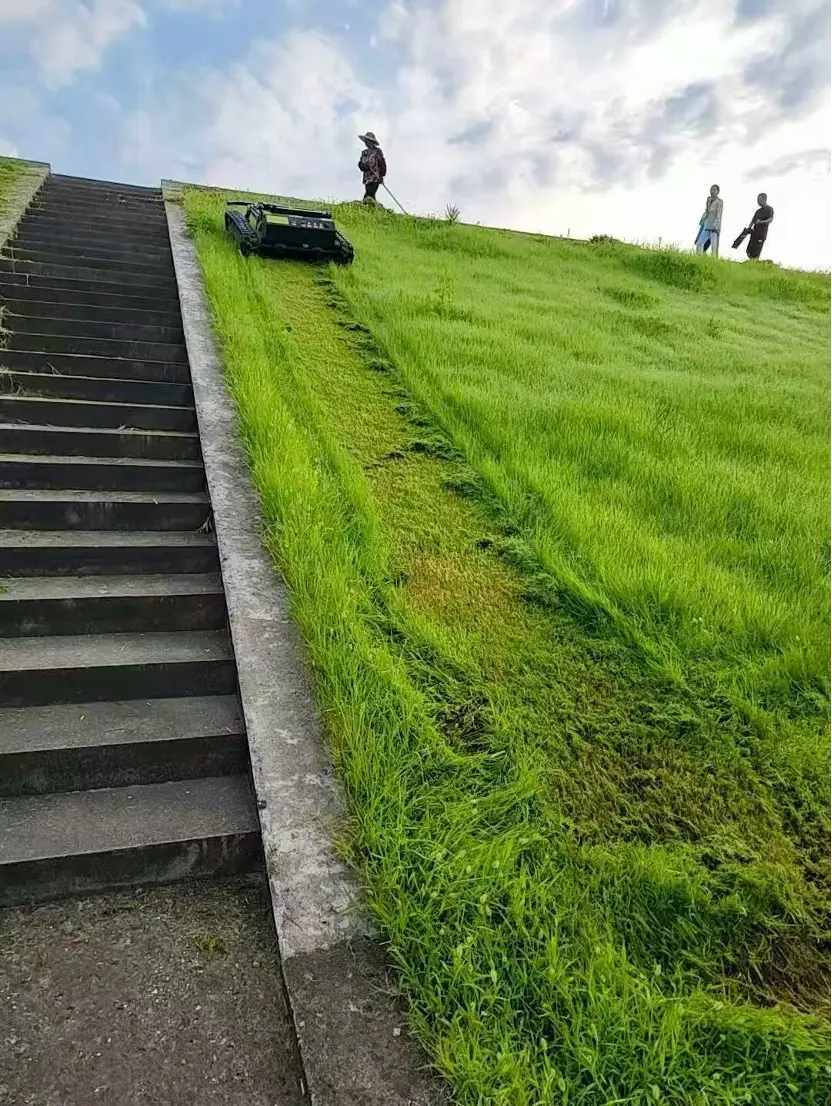
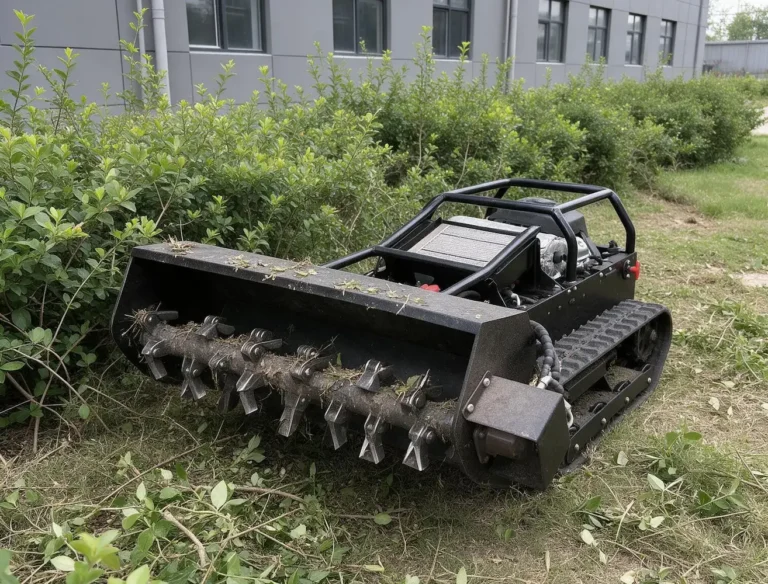
(Trimmora's SlopeMaster 800 Pro Climbing Work Picture)
Steep slopes, roadside embankments, uneven grassland, and overgrown hillsides can make vegetation management difficult for conventional mowing equipment. For landscaping contractors, municipal maintenance teams, and vegetation management companies, choosing the right slope mower can affect productivity, operating costs, and job-site safety.
Remote-control mowers offer an alternative by letting operators control the machine from a suitable position outside the immediate operating area. However, not all remote-controlled slope mowers use the same drive system.
One of the most important purchasing decisions is whether to choose a wheeled or tracked slope mower.
Both designs have advantages. Wheeled machines can offer excellent maneuverability and low ground pressure, while tracked machines can provide useful traction and ground contact on challenging terrain. The better choice depends on the slope, surface conditions, vegetation, cutting requirements, and machine design.
This guide compares wheeled and tracked remote-controlled mowers for steep slopes and explains what commercial buyers should evaluate before purchasing.
1. What Is a Slope Mower?
A slope mower is designed to maintain grass and vegetation on inclined or difficult-to-access terrain. Applications include highway embankments, roadside verges, drainage channels, reservoirs, commercial properties, solar farms, agricultural land, and orchards.
A remote-controlled slope mower allows the operator to control travel direction, speed, and mowing functions remotely, depending on the machine's design.
Compared with conventional mowing equipment, a remote-controlled machine can reduce the need for an operator to ride or walk directly alongside the cutting equipment. The operator must still maintain a suitable position, visibility, and control of the working area, following the manufacturer's operating instructions.
For commercial applications, select the right slope mower based on actual working conditions, not the maximum slope figure alone.
Important factors include:
◇Maximum operating slope and the conditions under which it is rated
◇Traction and machine stability
◇Wheeled or tracked drive system
◇Machine weight and ground pressure
◇Cutting width and vegetation type
◇Remote-control range and visibility
◇Transport, maintenance and service requirements
2. Wheeled vs. Tracked Slope Mowers: What Is the Difference?
Wheeled and tracked mowers transfer power to the ground differently. These differences affect maneuverability, traction, surface disturbance, and the types of work each machine suits.
Wheeled Slope Mowers
Wheeled remote-controlled mowers often combine four-wheel drive, specialized steering, and a relatively lightweight chassis.
Some models use all-wheel steering or an omnidirectional movement system to change direction without conventional turning maneuvers. Certain machines also use a stabilizing winch to support operation on very steep slopes.
Potential advantages include:
◇Maneuverability: Specialized steering systems can help the mower navigate around obstacles and change direction efficiently.
◇Lower ground pressure: A relatively lightweight machine can reduce surface pressure, depending on tire design and operating conditions.
◇Transport: Some compact models can be easier to transport between job sites, depending on machine dimensions and weight
◇Versatile mowing: Depending on the cutting system, a wheeled slope mower may handle maintained grass as well as some heavier vegetation.
However, wheeled machines are not automatically suitable for every steep slope. Tire traction, surface moisture, soil composition, steering design, and the availability of a stabilizing system all influence performance.
On loose soil, slippery vegetation, or uneven ground, buyers should evaluate the complete machine and its approved operating conditions rather than assuming that four-wheel drive alone guarantees safe operation.
Tracked Slope Mowers
Tracked remote-controlled mowers use continuous tracks instead of conventional tires. Their larger contact area can help distribute the machine's weight and provide traction on certain types of difficult terrain.
Potential advantages include:
◇Ground contact: Tracks can provide a relatively large contact area, depending on track width and chassis design.
◇Traction on uneven terrain: A suitable tracked system can be useful on rough ground, inclines, and areas where tire traction is limited.
◇Vegetation management: Heavy-duty tracked machines may be configured for tall grass, dense weeds, and brush, depending on engine power and cutting attachment.
◇Challenging work sites: Tracks can help where the ground is irregular, or the mowing area is difficult to access.
Tracked mowers also have limitations. Their performance depends on track design, machine weight, center of gravity, ground clearance,e and the terrain itself. Skid steering can disturb turf during tight turns, particularly on wet or unstable ground.
A tracked chassis should therefore be evaluated as part of the complete machine rather than treated as a guarantee of superior performance.
3. Wheeled vs. Tracked Slope Mowers: Comparison Table
Neither system is universally better. A wheeled mower with a suitable stabilization system may suit certain steep, maintained grass areas, while a tracked machine may be better for other difficult-terrain applications.
Base the decision on the actual work site and the manufacturer's operating limits.
4. What Can Buyers Learn from SPIDER Slope Mowers?
SPIDER is a useful market reference when comparing wheeled remote-controlled mowers for professional slope maintenance.
Its product range illustrates why the drive system alone does not determine a machine's slope capability.
For example, the SPIDER ILD01 HYDRO TWIN uses a wheeled chassis and a specialized steering system. Its published specifications include an 18 HP engine, an 80 cm cutting width, and a stated climbing ability of up to 55 degrees.
The SPIDER 2SGS EFI is another wheeled example. Its published specifications include a 25.5 HP engine and a 123 cm cutting width. SPIDER states that this model can operate on slopes up to 60 degrees when equipped with its stabilizing winch, compared with 41 degrees without the winch.
These are manufacturer-published specifications, not a guarantee of performance on every surface. Buyers should confirm the applicable operating conditions and safety requirements for the specific model.
The practical lesson is that a slope mower's performance depends on several interacting design features:
◇Drive and steering system
◇Machine weight and center of gravity
◇Tire or track configuration
◇Stabilizing winch, where applicable
◇Cutting deck design
◇Surface conditions and operating direction
A wheeled machine with a purpose-designed stabilization system can therefore be a serious option for steep-slope work. Similarly, assess a tracked machine by its complete configuration rather than assuming it suits every incline.
For buyers comparing brands, the most useful question is not simply "Wheels or tracks?" but "Which complete machine configuration is appropriate for my site?"
5. What is the Maximum Slope for a Remote-Controlled Slope Mower?
Maximum slope capability is one of the most visible specifications when comparing a steep slope mower for sale. However, you must interpret slope figures carefully.
First, distinguish between degrees and percentage grade.
A 45-degree slope is a 100% grade, not 45%. Confusing these measurements can lead to incorrect equipment selection. Second, a published maximum slope is not necessarily the same as a recommended working slope for every condition.
Actual performance may be affected by:
◇Wet grass, mud, or loose soil
◇Side-slope versus straight-line operation
◇Surface irregularities and hidden obstacles
◇Machine weight and center of gravity
◇Cutting attachment and vegetation resistance
◇Stabilizing equipment and the manufacturer's operating procedure
Before purchasing a slope mower, request the manufacturer's technical documentation that explains how the maximum angle was determined, whether a winch is required, and which operating directions and surface conditions are permitted.
Never use a maximum angle to replace the machine's safety instructions.
6.Tracked slope mowers are designed for challenging terrain.
For contractors working on rough embankments, overgrown land, and other demanding sites, a tracked remote-controlled mower may be worth considering.
Tracks can help distribute machine weight over a larger contact area and provide traction on suitable surfaces. The benefits depend on the machine's weight, track width, tread design, ground clearance, and drive system.
For example, Trimmora's SlopeMaster 800 Pro is positioned for commercial slope mowing, while the TerrainCrusher 1000D is a tracked machine intended for demanding vegetation management. Trimmora's TerraTrak 550 (TRM-55L) is primarily used for weed control in orchards.
When comparing tracked slope mowers, buyers should evaluate more than the advertised maximum climbing angle.
Traction and stability
Check the machine's approved slope limits, weight distribution, track design, and operating procedures.
Cutting performance
Match the cutting system and available power to the actual vegetation. Grass, thick weeds, and woody brush can require different configurations.
Machine dimensions
Confirm that the mower can access the narrowest part of the site, pass through gates, and be transported using available equipment.
Surface protection
Consider how the tracks interact with the ground, especially during turns or when operating on wet turf.
Service and maintenance
Ask about replacement tracks, drive components, cutting parts, technical documentation, and spare-part availability.
You can also read our commercial guide to remote control mowers for highway embankments for more information about terrain, access, and slope-mowing requirements.
7. Which Slope Mower Is Better for Your Application?
The right choice depends on the type of work your company performs.
Highway Embankments and Roadside Maintenance
Roadside contractors should assess slope angle, vegetation density, access, visibility, transport, and the ability to establish a safe working area.
Both wheeled and tracked remote control mowers may be appropriate, depending on the terrain and the manufacturer's approved operating conditions.
Maintained Grass and Large Open Slopes
For regularly maintained grass, a wheeled mower with an appropriate steering and stabilization system may offer efficient movement and maneuverability.
Consider cutting quality, ground conditions, the required finish, and slope capability.
Rough Grass and Dense Vegetation
Where vegetation is tall, thick, or uneven, buyers should compare engine power, cutting-deck design, cutting height, and the machine's ability to handle the expected material.
A heavy-duty tracked mower may suit some demanding applications, but the cutting system must also match the vegetation.
Solar Farms, Orchards and Restricted Areas
These applications may require a compact machine with low overall height, suitable ground contact, and the ability to work around obstacles.
The most appropriate drive system depends on the site's slope, row spacing, soil conditions, vegetation, and access limitations.
8. What to Check Before Buying a Slope Mower for Sale
If you are looking for a slope mower for commercial use, use this checklist before requesting a quotation.
1. Define the working environment
Record the steepest sections, surface type, soil moisture, vegetation density, and access limitations.
2. Confirm the rated slope capability
Ask for the operating manual and clarification of the conditions under which the stated maximum slope applies.
3. Compare the complete drive system
Evaluate tires or tracks, steering, ground clearance, machine weight,t and any stabilizing winch.
4. Match the cutting system to the vegetation
Specify whether the job involves maintained grass, tall weeds, brush, or mixed vegetation.
5. Estimate productivity
Compare cutting width, travel speed, turning requirements, and realistic working conditions. Published theoretical productivity may differ from actual field output.
6. Review transport requirements
Check machine dimensions, weight, loading arrangements, and the required transport vehicle or trailer.
7. Consider ownership costs
Include fuel or electricity, routine maintenance, wear parts, shipping, spare parts,s and expected service requirements.
8. Confirm supplier support
For B2B buyers, ask about technical documentation, spare parts, warranty terms, operator training, and long-term supply capability. A machine with a lower purchase price may not provide the best value if it does not match the application or is difficult to maintain.
9. Looking for a Remote Control Slope Mower for Sale?
For commercial buyers, start by defining site conditions and required performance before comparing individual models.
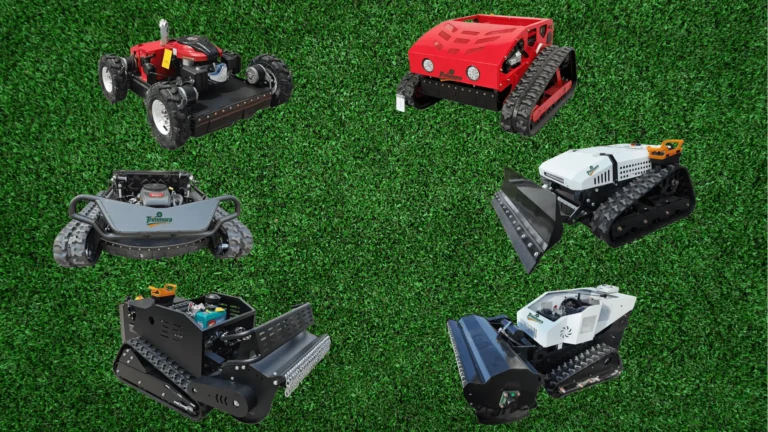
Trimmora manufactures remote-controlled mowing equipment for commercial applications, including slope mowing and difficult-terrain vegetation management.
Our range includes tracked machines for different working conditions. For example, the SlopeMaster 800 Pro is positioned for slope mowing, while the TerrainCrusher 1000D is designed for demanding tracked vegetation-management applications.
The appropriate model depends on the slope, surface conditions, vegetation, access requirements, and other technical considerations. Buyers should confirm the selected machine's current specifications and operating limits before making a purchasing decision.
Explore our commercial remote control lawn mower range to compare available models.
For distributors, machinery dealers, and commercial equipment companies, Trimmora also provides opportunities to discuss OEM/ODM and B2B supply cooperation.
When requesting a quotation, include your target market, application, expected order quantity, terrain conditions,s and any customization requirements. This helps the manufacturer recommend a suitable configuration.
Conclusion: Choose the Drive System for the Job
Wheeled and tracked remote control mowers both have a place in professional slope maintenance.
Wheeled models can offer excellent maneuverability and low ground pressure, while tracked models can provide useful ground contact and traction on suitable difficult terrain. Stabilizing systems, machine geometry, cutting performance, and surface conditions can matter as much as the choice of wheels or tracks.
For contractors and B2B buyers, the best slope mower is not necessarily the machine with the highest advertised climbing angle. It is the machine whose documented capabilities, cutting system, operating limits, and ownership costs match the actual job.
Before choosing a steep slope mower, evaluate the complete machine, verify the manufacturer's operating instructions, and compare total cost of ownership—not just the drive system or headline specification.
Looking for a remote control slope mower for your market? Explore Trimmora's product range or contact our team to discuss your application and B2B requirements.