Get Factory-Direct Wholesale Pricing & Catalog - WhatsApp:8615954555812!
Remote Control Lawn Mowers for Solar Farms: A Commercial Guide
We all know that solar power plants require regular vegetation management. Otherwise, weeds will grow under and between the solar panels. If they are not cleaned regularly, they will directly block the light-harvesting surface of photovoltaic modules. This reduces light energy utilization, lowers power generation, and can damage equipment. In the long run, this also reduces revenue from power generation and increases equipment maintenance costs.
Meanwhile, solar power plants often pose additional challenges due to their location on slopes, uneven terrain, electrical infrastructure, and narrow panel spacing. Traditional mowing equipment may struggle to operate in narrow row spacing. For large solar installations, the question is not simply "Can the grass be cut?" The real question is whether mowing equipment can efficiently manage vegetation while protecting the site and keeping operators away from hazardous areas.
Remote-controlled lawn mowers can be especially useful for commercial solar farm vegetation management because they let operators control the machine from a safer distance while still accessing difficult terrain and narrow work areas.
Why Vegetation Management Matters on Solar Farms
Photovoltaic panels will make weeds and wild grasses grow faster
Most people think that because the photovoltaic panels block the sun, the plants below will be affected and will not grow much.
However, when a large number of photovoltaic panels cover the ground, the environment here undergoes a wonderful change. Because the photovoltaic panels block sunlight, evaporation decreases and soil moisture increases, creating conditions for grassland to grow. Over time, unmanaged vegetation can become dense and difficult to control.
Before long, weeds will wrap around the photovoltaic power station, which is not good.
Weeds can obstruct access to the passage
The rapidly growing weeds not only surround the power plant equipment but also block the maintenance channels, making it difficult for maintenance personnel to enter the photovoltaic power plant for inspection and equipment maintenance. In an emergency, this can make it more difficult for personnel to access the site.
Increase safety risks such as fire hazards
Weeds that grow in summer wither and die in winter, becoming highly flammable fuel. Managing photovoltaic power plants poses significant challenges.
Maintaining Long-Term Site Accessibility
Solar power plants are usually not built in one go, but are operated for long-term vegetation management to improve overall power generation efficiency and continuously increase revenue.
Why Solar Farms Are Difficult to Mow
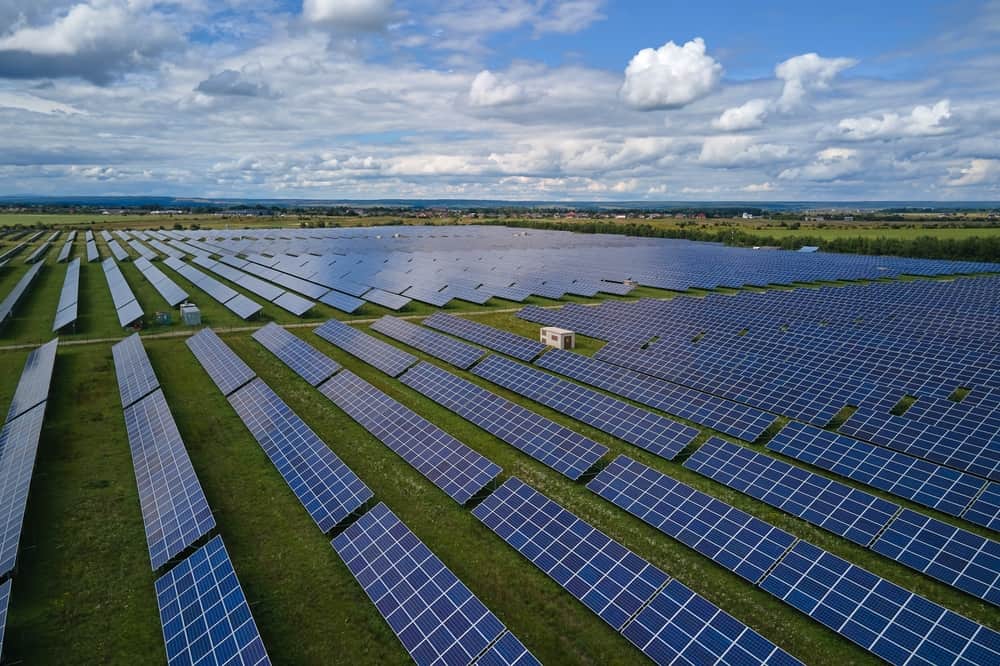
Narrow Spaces Between Solar Panel Rows
The main challenges faced in solar power plants are narrow working corridors between the panels, limited turning space, and repetitive panel arrangement, which increase the difficulty for traditional lawn mowing equipment and personnel to mow.
Low Clearance Under Solar Panels
The gap between the ground and the lower edge of some solar installations is relatively low. This creates challenges for personnel entry and traditional lawn-mowing equipment, especially at narrow distances too close to the ground to install. Therefore, the equipment needs to meet the following requirements: Compact size/low rise design/precise maneuverability, as shown in the following figure:
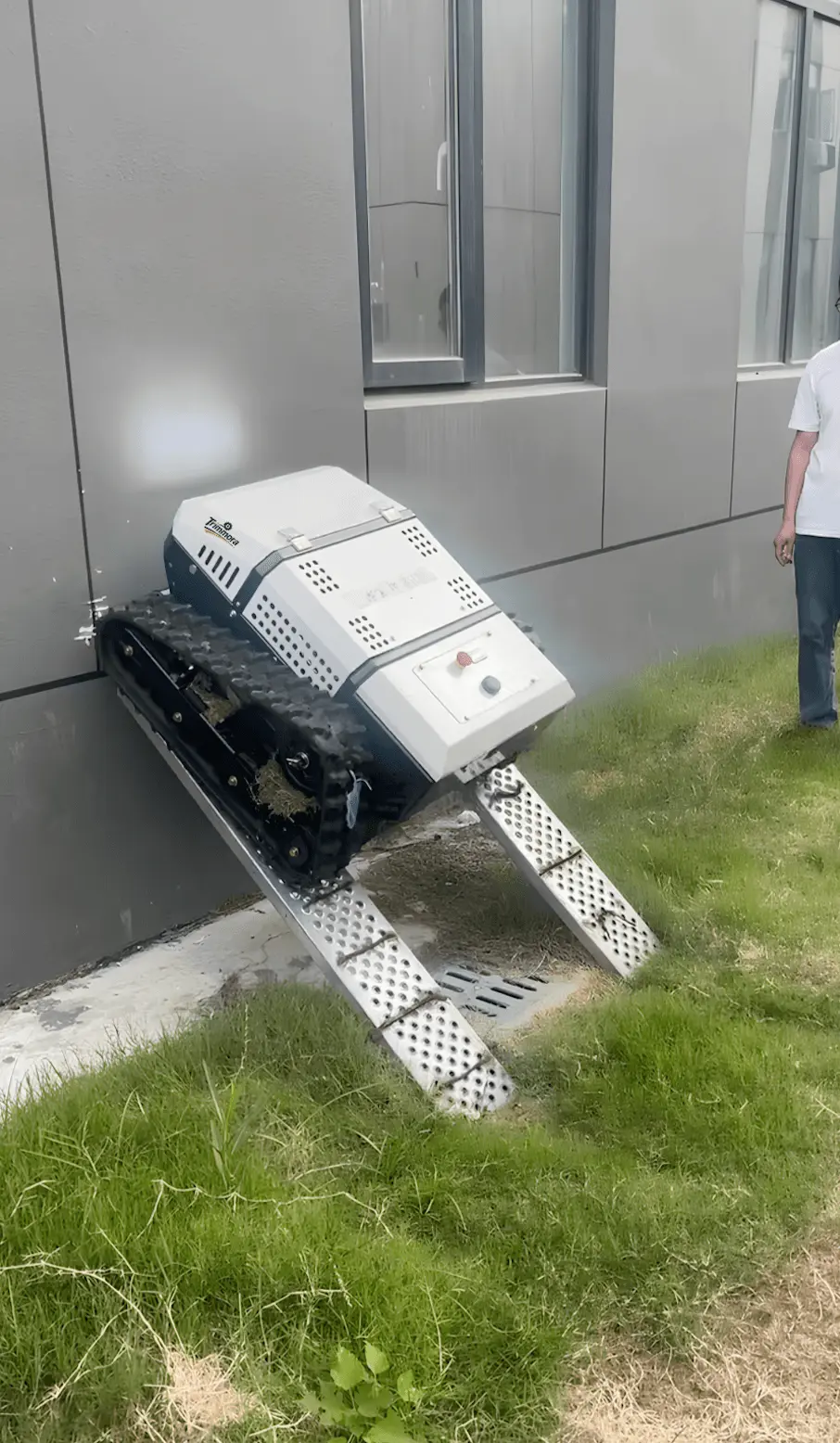
The maximum height of the lawn mowing equipment is 45cm, the width is 84cm, and the front slope design is conducive to entering narrow plots of land
Uneven or Sloped Terrain
Solar farms are not always built on flat ground. Sites are increasingly installed on:
▪Slopes and hillsides
▪Uneven ground and rolling topography
▪Retention embankments and drainage ditches
▪Rough, unpaved terrain
Operating conventional ride-on machinery across these uneven areas carries significant rollover risks. (For a deeper breakdown on managing severe angles, see our dedicated guide on Remote Control Lawn Mowers for Steep Slopes).
Electrical and Infrastructure Hazards
Solar installations are densely packed with operational infrastructure, including:
▪Inverter stations and electrical substations
▪ Surface cables and conduit lines
▪ Ground-mount framing and perimeter fencing
▪Utility corridors
In these environments, equipment selection and controlled operation matter far more than speed alone. The goal is to clear vegetation reliably around high-value assets without risking physical contact with sensitive electrical components.
How Remote Control Mowers Fit Solar Farm Maintenance
Remote Operation Around Difficult Areas
The core advantage of remote-controlled vegetation management lies in a fundamental operational shift:
[Operator] ---> ( Handheld Remote Controller ) ---> [ Tracked Machine ]
Instead of sitting or riding on the machine, the Operator controls all moving components, cutting height, and travel speed from a safe distance via an ergonomic wireless transmitter.
In complex commercial environments like solar farms—where uneven ground and structural obstacles are constant hazards—this structural shift delivers critical operational and commercial benefits:
1. Direct Visual Clarity (Better Visibility): Riding directly atop traditional commercial mowers often restricts the driver's view, creating blind spots around low-hanging panel frames, ground wires, and structural support legs. Remote operation lets workers move to an elevated position or an ideal side angle. This gives the Operator an unobstructed line of sight to place the cutting deck accurately around high-value assets without collision risks.
2. Enhanced Workplace Safety (Away from the Cutting Deck)By maintaining a safe standoff distance, operators are removed from primary job-site hazard zones. They are no longer exposed to: Rotating cutting decks and thrown debris (rocks, gravel, micro-cables); engine heat, exhaust emissions, and continuous chassis vibration; severe tip-over or rollover hazards when maneuvering near drainage ditches and steep slopes
3. Precise Positioning in Confined Corridors (Easier Positioning)Fine-tuning mechanical movements near delicate equipment is vastly easier with precision joystick inputs. Operators can make micro-adjustments in real time, easing machine positioning around tight corners, fence lines, inverter pads, and array support poles where heavy ride-on equipment struggles to maneuver.
4. High Efficiency Across Uneven Terrain. Dynamic ground conditions—such as soft soil, rutted tracks, hidden rocks, and sloping embankments—greatly reduce an operator's stamina and speed on conventional mowers. Remote control lets the tracked machine absorb ground shocks and negotiate difficult terrain seamlessly, keeping operations moving efficiently through long work shifts.
Compact Design for Narrow Working Areas
Modern solar farms are engineered to maximize surface area and energy yield, which means row spacing between solar arrays is often kept as tight as possible. For maintenance crews, these tight passages present a major operational bottleneck.
A compact tracked mower can move through narrow vegetation corridors between solar panel arrays where larger conventional equipment may be difficult to maneuver.
Unlike bulky tractors, zero-turn ride-ons, or wide-deck commercial mowers that risk scuffing panel frames or getting stuck in tight spots, a compact remote-controlled mower offers several key physical advantages:
▪Minimal Footprint: The streamlined width of a compact chassis allows the machine to traverse panel aisles with generous side clearance on both sides, reducing collision risks with mounting poles.
▪Tight turning maneuverability: With tracked zero-turn capabilities, the mower can pivot on its own axis at the end of a row, eliminating the complex multi-point turns required by larger machinery.
▪Unrestricted Flow: Crews can maintain a continuous, linear mowing path along entire panel rows without slowing down to squeeze through tight structural bottlenecks.
By utilizing equipment purpose-built for narrow working areas, contractors and solar farm operators can cover more ground per shift while virtually eliminating equipment-to-panel contact damage.
Low-Profile Design Under Solar Panels
When commercial buyers search for solar farm maintenance equipment, it is easy to assume that any remote-operated machine will get the job done. However, this is one of the most common—and expensive—procurement missteps.
Remote control capability alone does not make a mower suitable for solar farm maintenance.
The reality is that not every remote control mower is equally suitable for solar farms.
While many standard remote control mowers are built for open slopes or roadside clearing, utility-scale solar arrays present a very specific physical barrier: low overhead panel clearance. Solar panels are often installed at fixed tilt angles or mounted on single-axis trackers that tilt low to the ground, creating restricted overhead clearance that can easily trap or strike tall equipment.
To determine whether a machine can actually perform safe, efficient under-panel mowing, commercial buyers must look beyond the remote control feature and evaluate five critical design factors:
▪Overall Machine Height: The highest point of the machine chassis (including air filters, engine guards, and roll bars) must sit comfortably below the lowest tilt edge of your solar panels with ample safety margins.
▪Overall Machine Width: A low-profile mower must balance stability with a narrow profile. If a machine is too wide, it cannot fit between array posts; if it is too narrow without a proper low center of gravity, it risks instability.
▪Turning Behavior: Under low panels, there is no room for wide turning radii or awkward multi-point maneuvers. Equipment must feature true zero-turn capability on its own axis to reverse or pivot cleanly without swinging the rear of the machine into panel legs.
▪Cutting Deck Position: The position of the cutting deck dictates how close you can trim relative to the machine’s outer footprint. Front-mounted or out-front decks allow the machine to cut underneath panel edges and structural crossbeams before the chassis passes through.
▪Operator Visibility: Even with a low-profile machine, clearing vegetation under low panels requires precision. The machine’s design must let the operator maintain clear line-of-sight to the deck edges and panel legs from a comfortable, standing position nearby.
By evaluating these structural parameters before purchasing, commercial buyers and maintenance contractors can select a truly purpose-built mower—ensuring high productivity without costly panel strikes or unexpected site downtime.
What Makes a Remote Control Mower Suitable for Solar Farms?
If you are looking for a remote-controlled lawn mower suitable for solar fields, you should pay attention to these key points
Key Features to Evaluate Before Buying
Navigating the commercial market for remote-controlled mowers can be overwhelming. To avoid buying equipment that fails on-site or creates unnecessary operational bottlenecks, commercial buyers should evaluate equipment based on site-specific physical constraints and operational requirements, not specs alone.
Here is what you should analyze before investing:
Machine Width and Height
In a solar farm environment, machine dimensions dictate operational access. A mower with superior cutting power is virtually useless if it cannot physically pass beneath lower panel frames or fit between tight array rows.
When evaluating machine width and height, buyers must carefully match mower dimensions against the farm’s minimum panel edge clearance and tightest row spacing. Choosing a low-profile chassis with a compact frame ensures the mower glides under tilted arrays without striking mounting brackets, panels, or crossbeams.
Track System and Ground Contact
While wheeled mowers may perform adequately on flat, manicured turf, solar farm environments demand superior ground contact. A heavy-duty rubber track system provides significant operational advantages across three challenging terrain conditions:
▪Uneven ground: The tracks can easily cross small car trenches, rocks, and concave terrain, while keeping the cutting platform level to prevent the chassis from getting stuck or hanging at high places.
▪Soft Soil: By spreading machine weight over a much larger surface area, tracks drastically reduce ground pressure. This prevents soil compaction and rutting, especially during wet seasons or in low-lying drainage zones.
▪Slopes& Embankments: Rubber tracks deliver high continuous traction, preventing lateral slide-offs when navigating perimeter slopes, ditch banks, and containment berms.
Cutting Width and Productivity
A common procurement assumption is that a wider cutting deck automatically speeds up job completion. However, in utility-scale solar vegetation management:
Wider cutting width doesn't always mean better performance.
Evaluating productivity requires balancing row spacing and cutting width.
If a cutting deck is too wide, operators will constantly struggle to maneuver around array support legs, gate openings, and narrow corridors—wasting time on multi-point adjustments and increasing collision risk. Conversely, a slightly narrower, highly agile cutting deck allows smooth, uninterrupted passes down rows, yielding higher overall daily acreage productivity.
Engine or Motor Power
The optimal power system depends directly on your on-site operating conditions, daily working hours, and environmental regulations:
Gasoline (or Hybrid) Power
Best suited for:
▪ Continuous operation: Working in multiple shifts continuously, quickly refueling on site.
▪ Vegetation: Through dense weeds, woody stems, and dense shrubs.
▪ Terrain: Steep slopes and rugged terrain require sustained high torque.
Electric Power
Best suited for:
▪Lower Noise Operations: Sites near residential areas or strict acoustic boundaries.
▪ Low-Emission Requirements: Facilities prioritizing sustainability and carbon offset goals.
▪ Charging-Ready Sites: Installations with accessible on-site charging infrastructure or solar microgrids.
(To gain a deeper understanding of the technology used to select power systems, please read our detailed article. The B2B Buyer’s Guide to Evaluating Battery & Motor Efficiency in Remote Control Lawn Mowers).
Remote Control Range and Visibility
When comparing device specifications, commercial buyers are often drawn to impressive transmission distances, such as remote ranges of several hundred meters. However, in the day-to-day maintenance of solar power plants, extreme operating distances are a misleading indicator.
Always evaluate remote-control range alongside actual on-site visibility and working conditions.
In real-world operations around solar arrays, maintaining direct line-of-sight visual contact is paramount. Operating a mower 200 meters away through dense rows of tilted panels makes it nearly impossible to judge deck depth, leading to missed vegetation patches or accidental collisions with structural mounting legs and surface cables.
A truly effective remote control system prioritizes signal stability, anti-interference reliability, and low latency within actual line of sight, allowing operators to maintain precise control while safely standing nearby.
Maintenance and Spare Parts
Utility-scale solar farms are long-term assets, and their vegetation management requires continuous, multi-year operating schedules. Because of this, purchasing decisions should never be based solely on the initial machine price.
Evaluating the true total cost of ownership (TCO) requires commercial buyers and contractors to look deeply into ongoing operational support, including:
▪High wear parts: availability and ease of replacement of consumables such as cutting blades, tracks, belts, etc.
▪Powertrain Reliability: Routine engine or electric motor servicing requirements and component durability under dust and high ambient temperatures.
▪Spare Parts Availability: Fast regional dispatch of critical replacement components to prevent extended machine downtime during peak growing seasons.
▪Technical Support & Service: Access to responsive manufacturer troubleshooting, wiring diagnostics, and reliable warranty backing.
Choosing a lower-priced machine with poor spare parts support often leads to costly job-site delays when a simple belt or blade cannot be sourced quickly.
To build a preventative service strategy for your fleet, explore our practical handbook: Remote Control Lawn Mower Maintenance: A Commercial Buyer’s Guide.
Where Remote Control Mowers Can Be Used on a Solar Farm
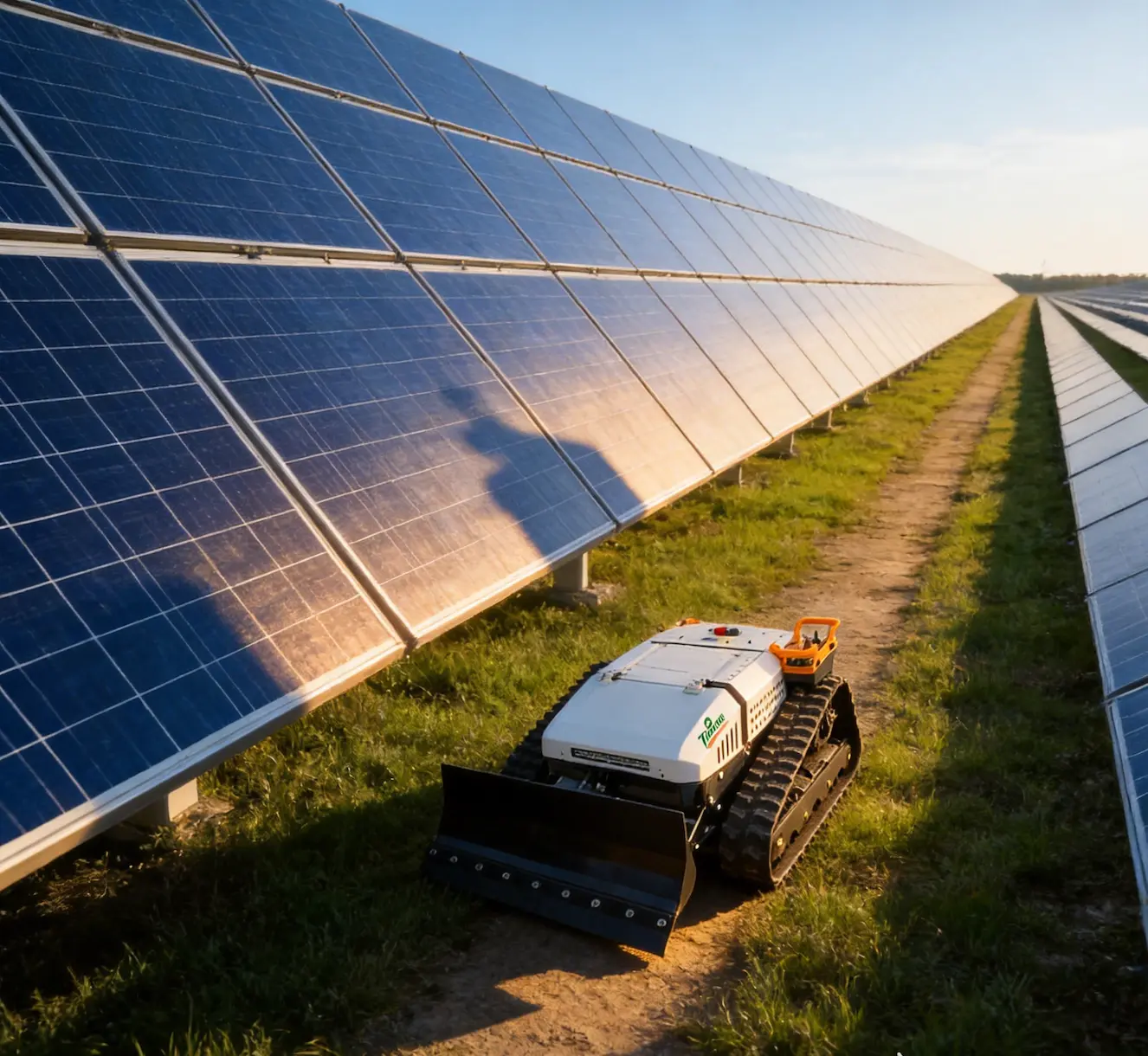
Between Solar Panel Rows
Around Solar Farm Perimeters
The outer boundary of a solar facility requires constant maintenance to preserve security visibility, prevent wildfire propagation, and allow unhindered access for emergency and inspection vehicles.
Remote-controlled mowers are highly effective for maintaining these surrounding operational boundaries, specifically around:
▪Fence Lines: Clearing tall weeds and climbing vines along security fencing without snagging traditional equipment or damaging boundary wire.
▪Perimeter Vegetation: Creating clean, consistent firebreaks and buffer zones between dense external brush and high-value solar assets.
▪Access Roads: Trimming roadside grass, overgrown ditches, and shoulder vegetation along service roads to ensure clear access for delivery trucks and maintenance fleets.
Sloped Areas
Solar farms are increasingly constructed on non-traditional agricultural land, including rolling hillsides, terraced plots, drainage swales, and steep retention basin embankments. Operating traditional ride-on tractors or zero-turn mowers on these inclines creates severe rollover risks and frequent traction loss.
Tracked remote-control mowers solve this safety bottleneck by keeping the operator securely on flat ground while the low-center-of-gravity machine maneuvers across challenging inclines.
(For an in-depth operational guide on managing severe incline angles, read our dedicated article: Remote Control Lawn Mowers for Steep Slopes).
Around Utility Infrastructure
Utility-scale solar farms contain critical electrical infrastructure and sensitive support zones. Maintaining surrounding growth is essential to prevent operational short circuits, equipment overheating, and pest infestations.
Remote-controlled mowers allow maintenance crews to execute precise, controlled vegetation management across key infrastructure zones, including:
▪Inverter area: Trim the lawn around the inverter base, but do not touch the equipment.
▪Electrical Substations: Managing perimeter ground cover near high-voltage substations while operators stand at a safe electrical standoff distance.
▪Service Zones: Keeping control sheds, monitoring stations, and equipment staging areas clear of overgrowth.
▪Pipeline & Utility Corridors: Maintaining low-profile clearance along buried cable runs, surface conduit pipes, and utility right-of-ways.
Operational Focus: The key goal in these zones is controlled vegetation management—using fine remote-controlled precision to trim dense growth cleanly around sensitive electrical assets without allowing the machine deck or chassis to physically contact high-voltage equipment.
Which Trimmora Remote Control Mower Is Suitable for Solar Farms?
Different areas of a utility-scale solar farm present very distinct physical challenges. Rather than taking a "one-size-fits-all" approach, Trimmora engineers specialized commercial remote-controlled mowers tailored to specific site conditions.
Here is how to select the right Trimmora model based on your job-site requirements:
1. For Low-Clearance & Narrow Panel Arrays
Core Application: Under-panel mowing, narrow row corridors, and low-profile tilt structures.
When navigating tightly spaced panel arrays with minimal ground clearance, machine dimensions are everything. Trimmora’s ultra-compact, low-profile tracked series is engineered specifically to glide beneath low-tilted panels without striking frame supports or delicate surface cables.
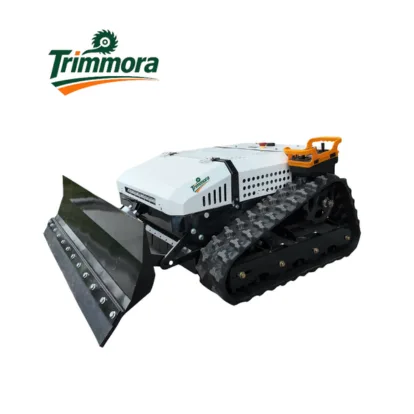
Trimmora EcoClean 550E has a height of 45 cm
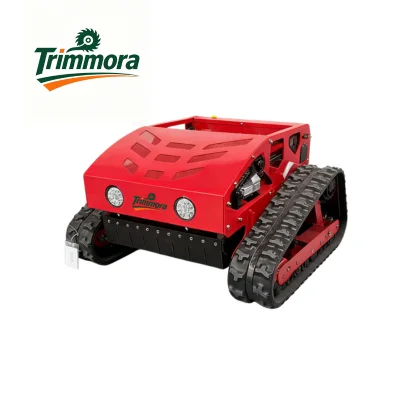
The Trimmora OmniRover 550 has a height of 43cm
2. For Large-Acreage Sites & Dense Vegetation
Core Application: High-density weeds, thick brush, expansive acreage, and long operational shifts.
For utility-scale solar facilities covering vast acreage, daily productivity and high cutting torque are paramount. Trimmora’s commercial-grade gasoline and diesel hybrid series combine wider cutting decks with high-horsepower engines, allowing maintenance teams to chew through heavy brush and cover thousands of square meters per hour.
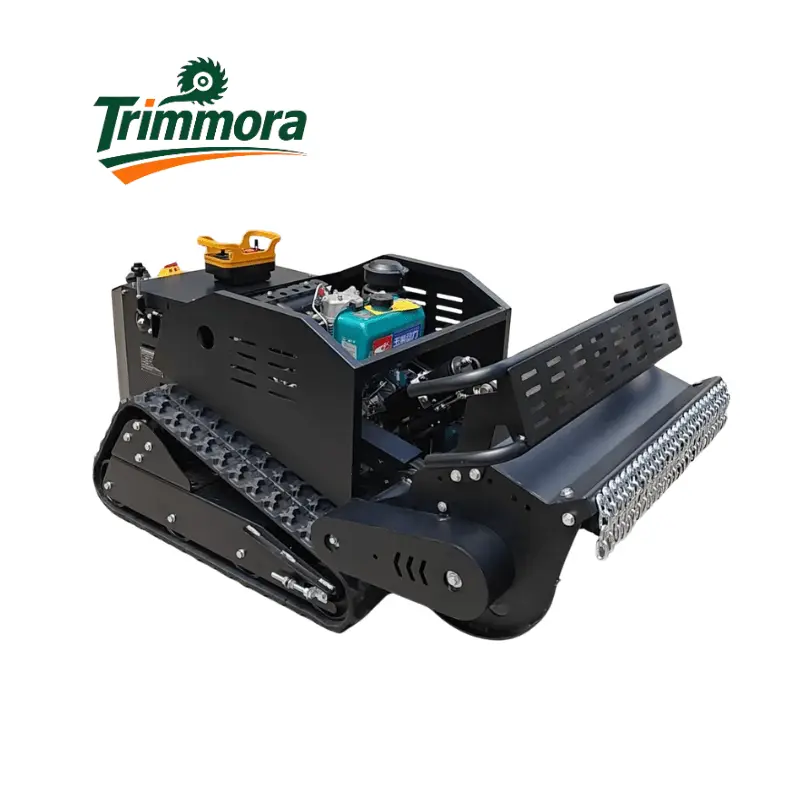
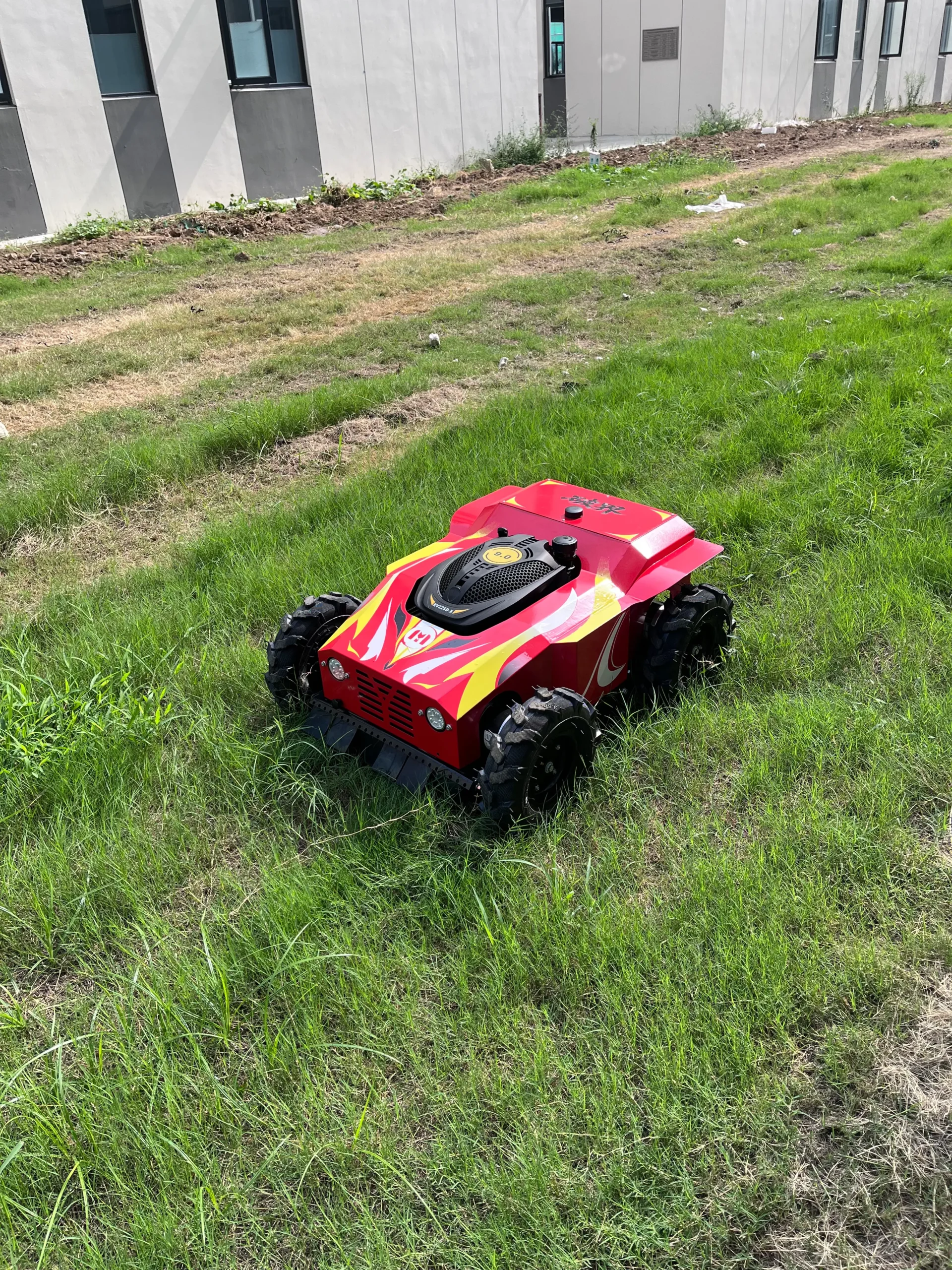
Trimmora Commercial Titan 800D
3. For Slopes, Swales & Rough Terrain
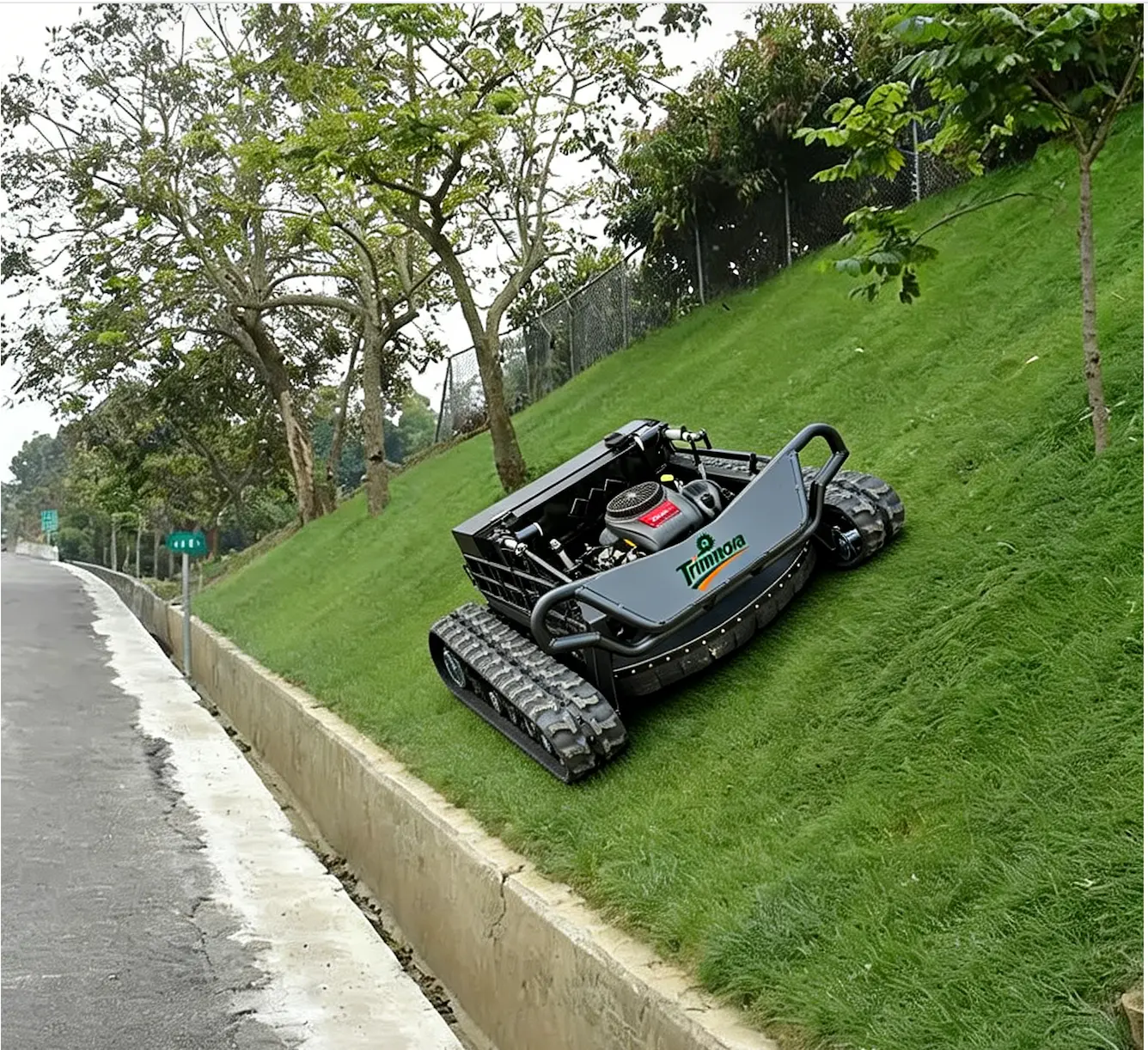
Core Application: Drainage ditches, retention embankments, hillside arrays, and uneven ground. Solar farms built on rolling hills or sloped terrain require unmatched mechanical stability. Trimmora’s slope-master series features heavy-duty rubber track systems and a low-center-of-gravity chassis designed to climb steep inclines and maintain traction without tipping.
Solar Farm Mowing: What Should Commercial Buyers Consider?
Purchasing remote-controlled mowing equipment for a solar facility is more than just buying a single machine—it is a fleet deployment decision. To ensure a seamless procurement process and long-term return on investment (ROI), commercial buyers and vegetation management contractors should evaluate four key operational pillars using this Procurement Checklist:
1. Site Conditions Assessment. Before looking at machine specifications, audit the target site's physical constraints:
[ ] Panel Row Spacing: Measure the narrowest path between array support legs and structures.
[ ] Minimum Panel Clearance: Determine the lowest overhead height at maximum tilt angles.
[ ] Ground Slope & Incline: Identify maximum slope angles along embankments and swales.
[ ] Soil & Surface Conditions: Note rutted ground, rocky terrain, or soft/marshy soil after rain.
[ ] Vegetation Density: Categorize growth types (standard turf, tough reeds, thick brush, or woody saplings).
2. Equipment Specifications Matching: Match site metrics against ideal machine features:
[ ] Machine Dimensions: Ensure machine width and total height leave adequate safety margins around arrays.
[ ] Cutting Width: Choose a deck size that balances daily acreage yield with tight-space maneuverability.
[ ] Power Source Strategy: Select Gasoline/Hybrid for continuous runtime or Electric for zero-emission mandates.
[ ] Track Configuration: Confirm track tread aggressiveness and chassis ground contact pressure.
[ ] Remote Control Reliability: Verify industrial radio frequency stability and anti-interference performance in high-EMF electrical environments.
3. Total Ownership & Product Support: Look beyond initial machine pricing to protect operational uptime:
[ ] Maintenance Requirements: Review daily servicing routines, grease points, and filter access.
[ ] Wear Parts Availability: Confirm rapid local availability for blades, drive belts, tensioners, and tracks.
[ ] Warranty Coverage: Verify warranty terms for structural components, engines, and electronic modules.
[ ] Technical Support Access: Ensure access to direct technical documentation and responsive factory support.
[ ] Shipping & Logistics: Calculate transit times, crate dimensions, and delivery logistics to your job site or yard.
4. Business & Fleet StrategyAlign equipment purchases with long-term commercial goals:
[ ] Required Fleet Size: Determine the number of units needed based on total site acreage and cutting cycles.
[ ] Projected Annual Operating Hours: Estimate duty cycle demands to establish a preventative service schedule.
[ ] Fleet Scalability: Plan for standardized equipment models to simplify spare parts stocking as your fleet expands.
[ ] Local Service Capabilities: Evaluate whether maintenance will be handled in-house or through local service partners.
Why Remote Control Mowing Can Make Sense for Solar Farm Contractors
When evaluating new machinery for utility-scale solar vegetation management, focusing solely on exaggerated claims like “saving 50% on labor” misses the bigger commercial picture.
For landscaping contractors, agricultural service providers, and specialized vegetation management companies, the true value of integrating remote-controlled mowers into your fleet lies in strategic business expansion, operational safety, and service consistency.
Here is why adding remote-controlled mowers makes compelling commercial sense:
1. Reduce Operator Exposure to Dangerous Terrain
Safety is an operational priority—and a massive liability factor—for commercial contractors. Riding traditional machinery over severe embankments, retention swales, or rutted terrain exposes crew members to severe rollover risks, physical fatigue, and engine heat.
Switching to remote-controlled equipment lets your crew operate from safe, stable ground. Reducing job-site injury risks not only protects your team but also helps minimize workers’ compensation claims and lowers overall business insurance liabilities.
2. Access Areas Where Conventional Equipment Fails
Standard commercial mowers, zero-turns, and tractor-drawn implements often can’t access solar farms because of tight row spacing, low panel clearances, or soft soil conditions.
Compact, tracked remote mowers give contractors a versatile tool that glides under low-tilt frames and negotiates narrow corridors where heavy ride-on machinery cannot operate—eliminating the need for slow, labor-intensive manual string trimming in those restricted spaces.
3. Improve Vegetation Management Consistency
Inconsistent vegetation trimming leads to panel shading, which directly degrades solar power yield and prompts client complaints.
Because remote operators can step back to view the machine’s cutting line from an optimal visual vantage point, they can maneuver close to structural posts, perimeter fences, and inverter pads with exceptional precision. The result is a cleaner, more uniform cut across the entire facility without risking mechanical collisions with high-value electrical assets.
4. Expand the Range of Sites Your Business Can Service
Many solar asset managers enforce strict site access rules, rejecting contractors who rely exclusively on heavy, high-clearance, or high-ground-pressure machinery.
By adding purpose-built low-profile tracked remote mowers to your equipment fleet, your contracting business can confidently bid on—and win—complex, utility-scale maintenance contracts that competitors with standard equipment are forced to pass up.
5. Build a Specialized Commercial Mowing Service
The solar energy sector is expanding rapidly, driving enormous demand for specialized operations and maintenance (O&M) service providers.
Rather than competing in a crowded, low-margin market for standard commercial lawn care, equipping your fleet with specialized remote-controlled mowers positions your business as an expert utility-scale vegetation management provider. This specialization allows landscaping, agricultural, and vegetation contractors to command premium service rates, secure multi-year service contracts, and build long-term relationships with solar farm owners and site operators.
FAQ
Q1. Can remote-controlled lawn mowers be used on solar farms?
Yes, remote-controlled lawn mowers are widely used for vegetation management on solar farms. Because they operate via a wireless transmitter, operators can maintain a safe distance from high-voltage electrical equipment, moving blades, and low-hanging panel arrays. Their compact footprint and low center of gravity make them far safer and more effective than conventional ride-on mowers or agricultural tractors on solar sites.
Q2. Can a remote-controlled mower work between narrow solar panel rows?
Yes, as long as you choose a mower with a compact machine width and zero-turn capability. Modern utility-scale solar farms often feature narrow aisles between array mounting structures. A compact tracked remote mower can easily traverse these tight corridors, turning on its own axis at the end of each row without risking collision with structural support legs or solar frames.
Q3. What type of mower is best for solar farm vegetation management?
The ideal option is typically a low-profile, tracked remote-controlled mower. To maintain a solar site effectively, a mower must offer low overhead clearance to pass beneath tilted panels, narrow chassis dimensions to fit between rows, rubber tracks for traction on uneven ground, and enough cutting power to handle tough weeds and thick grass.
Q4. Are tracked remote control mowers suitable for uneven solar farm terrain?
Yes, tracked remote control mowers excel on uneven ground, soft soil, and sloped embankments. Unlike wheeled machinery that can slip or get stuck in ruts, rubber track systems distribute the machine’s weight over a larger ground contact area. This reduces soil compaction, prevents rutting after heavy rains, and provides superior mechanical traction on steep ditch banks and retention berms.
Q5. Should I choose a gasoline or electric remote control mower for a solar farm?
The choice depends on your daily operating hours, vegetation density, and site infrastructure:
Choose Gasoline (or Hybrid): If you manage large-acreage sites requiring continuous long-hour shifts, fast job-site refueling, and high engine torque to cut through thick, overgrown brush.
Choose Electric: If your facility requires zero-emission operations, strict noise controls (e.g., sites near residential areas), or easy access to on-site charging stations.
Q6. What should I consider when buying a remote control mower for commercial solar farm maintenance?
Commercial buyers should look beyond machine price and evaluate total operational fit. Key factors include panel clearance height, row spacing width, slope-climbing capability, track configuration, cutting-deck durability, and remote-control signal stability. Additionally, long-term ownership factors—such as local spare-parts availability, warranty coverage, and manufacturer technical support—are critical to preventing costly machine downtime.
Looking for a Remote Control Mower for Your Solar Farm?
Tell us about your solar farm conditions, including panel row spacing, terrain, vegetation density, and required working area. The Trimmora team can recommend a suitable remote control mowing solution for commercial vegetation management.
Trimmora commercial remote control mowers are designed for demanding working environments, including steep slopes, orchards, solar farms, roadside vegetation management, and large properties. Explore our guide to commercial remote control mower applications to see how different mower configurations can match different terrain and maintenance requirements.
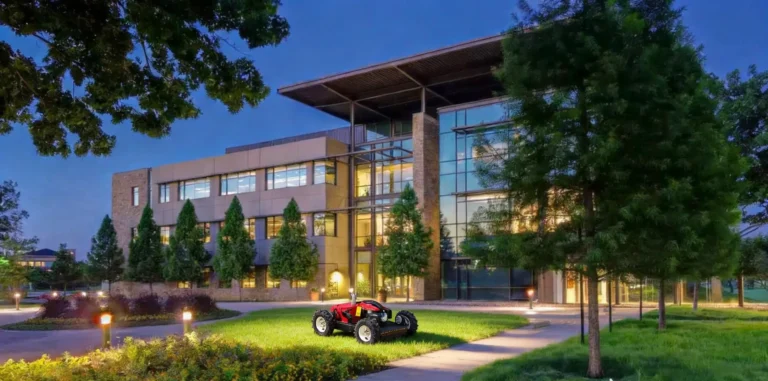
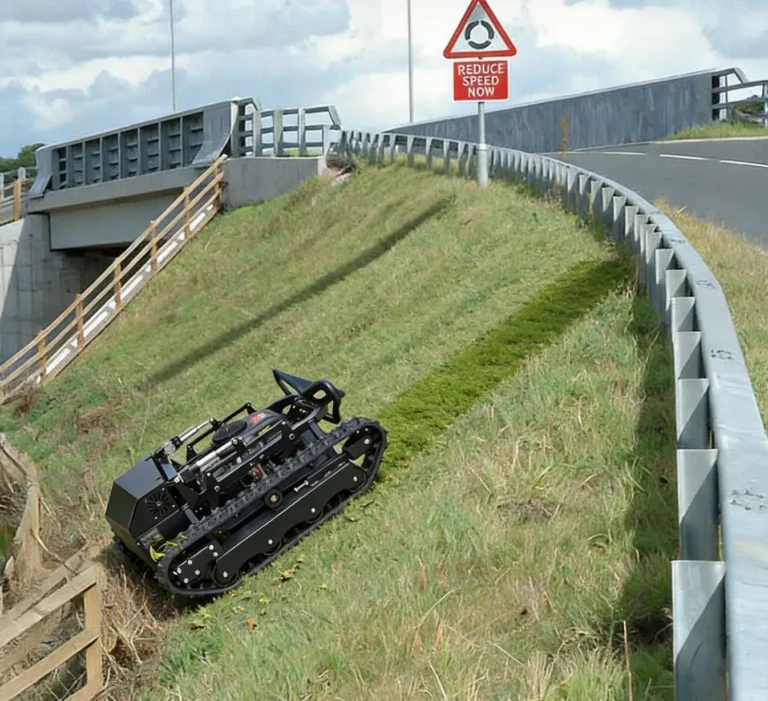
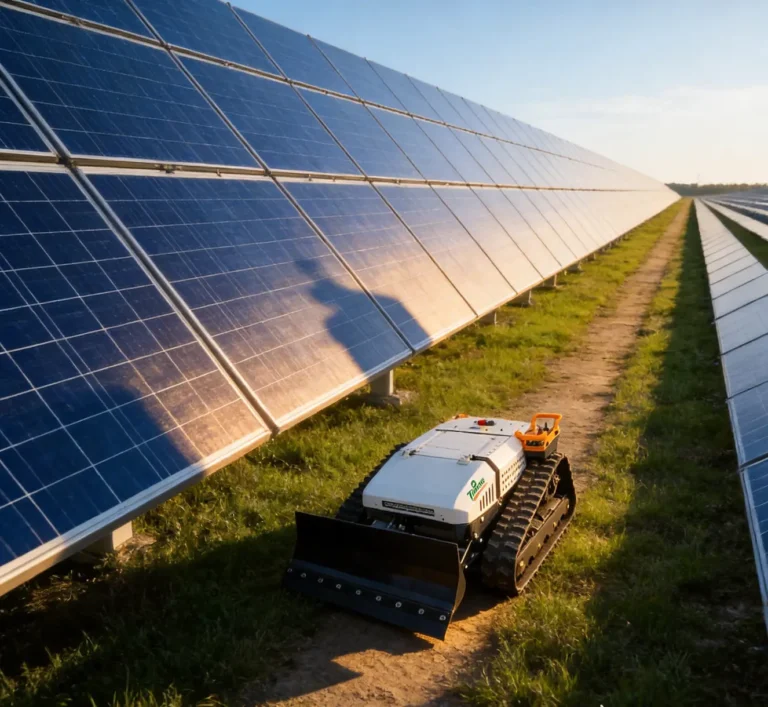
[…] Utility infrastructure sites present unique maintenance challenges. Solar farms, electrical substations, and pipeline corridors feature thousands of ground obstacles and narrow clearance zones where heavy machinery cannot fit, yet vegetation must be controlled to prevent shading and fire hazards.Key Environments:◆Solar photovoltaic (PV) panel arrays, ◆Eectrical substations and powerline corridors◆Pipeline rights-of-way◆Water treatment plants and infrastructure perimeter fencesWhy Remote Control Matters:◆Low Clearance Design: Compact, low-profile mowers easily slide underneath low-mounted solar panels without damaging expensive PV modules or racking.◆Precision Maneuvering: Remote operation gives crews a clear line of sight around delicate wiring, posts, and ground-mounted equipment.◆Fire Mitigation: Regular brush control reduces dry vegetation buildup, eliminating fire hazards around high-voltage equipment.For a more detailed look at vegetation management around photovoltaic installations, see our guide to remote control lawn mowers for solar farms. […]
[…] also be useful when you need different vegetation-management attachments.See our detailed guide to remote control lawn mowers for solar farms for more […]